A More Comfortable Way to Get the Answers You Need at the Doctor
Magnetic Resonance Imaging (MRI) has revolutionized medical diagnostics, enabling clinicians to visualize detailed images of the body’s internal structures without invasive procedures. Yet, for many patients, the process of undergoing traditional MRI scans can create stress and anxiety. The discomfort of lying still inside a narrow tube, combined with loud scanning noises, often leads to feelings of claustrophobia and unease. Fortunately, the introduction of upright MRI technology, a patient-centered advancement, seeks to address these challenges. For those seeking a more comfortable alternative, options like stress free MRI Deerfield offer a new standard in patient-focused imaging.
This innovative approach not only benefits those with anxiety or mobility issues but also provides unique diagnostic advantages. Upright MRI is designed for comfort and accuracy, positioning patients in standing or seated postures to offer a true-to-life view of anatomical conditions. As healthcare continues to evolve, upright MRI systems are setting a new benchmark for imaging excellence and accessibility. The switch from confined supine machines to open, upright scanners is changing both how patients feel during their scans and how effectively clinicians can observe certain conditions.
Understanding Upright MRI
Traditional MRI systems require patients to lie flat and remain completely still inside a closed, tubular chamber. While effective, this setup presents problems for individuals with claustrophobia or those who find it painful to maintain a supine position. Upright MRI machines, in contrast, feature an open design that allows patients to sit or stand during the procedure. This configuration not only improves overall patient comfort but also enables scanning under natural weight-bearing conditions. By capturing images while patients are seated or standing, clinicians gain more clinically relevant data, especially for conditions that are exacerbated by gravity, such as spinal compression, joint instability, or specific brain pathologies.
The open architecture and patient-friendly environment of upright MRI scanners have significantly improved both clinical outcomes and patient experiences. The design accommodates a wider array of body types, physical limitations, and comfort needs, making advanced imaging accessible to a more diverse patient population than ever before.
Benefits of Upright MRI
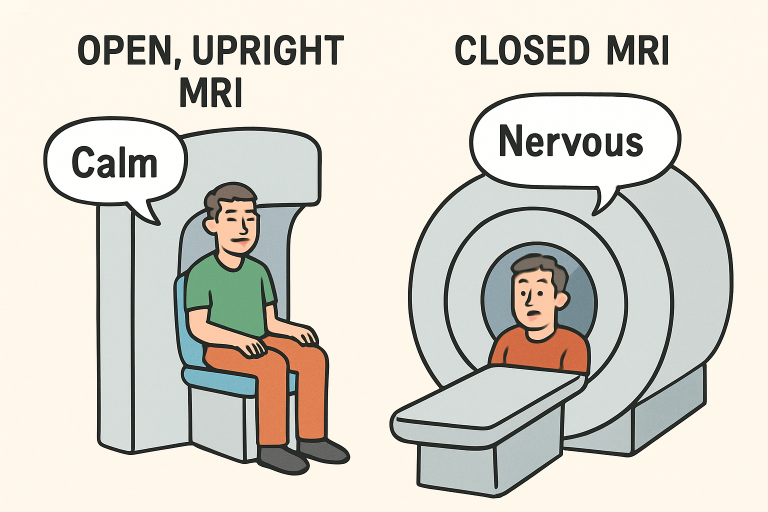
- Enhanced Comfort: Open, upright imaging drastically reduces anxiety in enclosed spaces, creating a calmer, more manageable experience.
- Weight-Bearing Imaging: Postural MRI scans allow clinicians to observe spinal misalignments, herniated discs, and joint issues with greater accuracy, revealing abnormalities that static supine images might miss.
- Versatility: Upright systems are designed to accommodate patients with mobility difficulties, pediatric and elderly populations, and individuals with special needs who may not tolerate traditional MRI scans.
Patient Experiences and Feedback
Recent clinical studies support the positive impact of upright MRI technology on patient well-being and scan outcomes. In a comparison of open upright MRI systems and closed-bore MRIs, researchers found that only 18.4 percent of patients in the upright environment experienced claustrophobia. In contrast, the rate in closed systems rose to 58.3 percent. Open upright systems also led to fewer prematurely terminated scans and a notable reduction in the need for sedatives. These benefits have improved the overall diagnostic journey, minimizing patient distress and increasing completion rates of essential imaging procedures. A detailed review in the National Institutes of Health’s database sheds light on these improvements.
Clinical Applications
Upright MRI is especially valuable for diagnosing complex musculoskeletal and neurological conditions. For instance, Ehlers-Danlos Syndrome (EDS), which often involves spinal instability, benefits from weight-bearing imaging. Traditional lying-down MRIs may not adequately demonstrate facet joint slips, vertebral misalignments, or cerebellar tonsil descent that can worsen under gravity. At the Medical University of South Carolina, a new upright MRI was explicitly installed to aid patients with EDS, highlighting the crucial role this technology plays in diagnosing rare or hard-to-assess disorders.
Accessibility and Availability
Despite the proven clinical and experiential advantages, upright MRI machines remain less common than their supine counterparts. The cost of installing and maintaining these advanced systems contributes to their slower adoption rate, although advocacy and fundraising efforts are expanding availability. More hospitals and imaging centers in the United States and Europe are recognizing the patient demand for upright MRI, integrating units into their facilities and reducing wait times for those seeking anxiety-free scanning.
As awareness grows, patients and referring physicians are also becoming more proactive about requesting upright MRI for cases where traditional imaging falls short. Large medical institutions and specialized clinics are leading the way in providing this option, with outcomes demonstrating improved diagnostics in fields ranging from orthopedics to neurology.
Future Prospects
The future of upright MRI technology is bright, driven by ongoing research and technical advancements. Manufacturers are dedicated to refining these scanners, improving image clarity, and developing software optimized for weight-bearing assessments. As these machines become more efficient and affordable, upright MRI will likely become a standard fixture in diagnostic imaging departments worldwide. With increased awareness and patient advocacy, this shift has the potential to transform how clinicians investigate and treat a broad range of conditions.
In summary, upright MRI represents a significant evolution in medical imaging. By prioritizing patient comfort and diagnostic precision, this approach empowers patients while equipping clinicians with superior information for personalized care. As installation expands and technology continues to advance, upright MRI is anticipated to become a mainstay of patient-friendly healthcare, offering a more compassionate and insightful scanning experience for all.